

From RMA to a New Era: Transitioning to the Planning Act and Natural Environment Act
Over the next few years, we will need to transition into the new resource management regime – here is what you need to know about the transition.
The Resource Management Act 1991 (RMA) is being replaced by two new pieces of legislation: the Planning Act (PA) and the Natural Environment Act (NEA). These reforms represent a fundamental shift in how land use is regulated and natural resources managed. The transition will take several years and involve a hybrid approach (a mix of RMA and PA/NEA) before full implementation of the PA and NEA.
Key shifts in the new regime
The new legislation will introduce a number of key shifts into the resource management regime. 5 key shifts are:
- Replacing Part 2 with “goals” – the “sustainable management” purpose of the RMA and sections 6 (matters of national importance) and 7 (other matters of importance) will be replaced with “goals” which define the scope of the resource management system. There is no hierarchy between goals – the relative importance of each will be expanded upon in national direction.
- More integrated national direction and standards – National Policy Direction (NPD) will be introduced for each Act. National standards will help implement the new system consistently across the country, replacing multiple overlapping instruments under the RMA.
- Fewer plans – Over 100 separate regional and district plans under the RMA will be replaced by 17 combined regional plans that integrate spatial planning, land use and environmental management. Nationally standardised zones and overlays will be introduced through national standards, reducing time and cost associated with local plan-making. Councils implementing planning controls relating to indigenous biodiversity/significant natural areas, significant historical heritage (including sites of significance to Māori), outstanding natural features and landscapes and areas of high natural character will need to consider whether landowners should be compensated via the regulatory relief regime. Read more about plan-making, including regulatory relief, here.
- Environmental limits – The NEA will require binding environmental limits to protect human health and the ecosystem – something the RMA did not fully implement. Central Government will set environmental limits for human health via national standards. Regional councils will set environmental limits in natural environment plans for ecosystem health in relation to freshwater, coastal water, air, land and soils, and indigenous biodiversity.
- Fewer consents – Increased direction from the top and a reduction in the scope of effects that can be considered will mean fewer consents will be required. The Government’s focus on enjoyment of private property rights means landscape and amenity effects are excluded from consideration (other than outstanding natural landscapes, areas of high natural character and significant historic heritage). Activities with less than minor effects will not require consent, and effects will be able to be managed by avoiding, minimising, remedying, offsetting or compensating – with no hierarchy amongst those mechanisms. Consent conditions will need to be proportionate.
Five things to know about the transition
Once the PA/NEA pass into law, the transition to the new system will start immediately. Here are 5 things you should know about the transition:
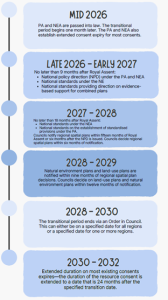
- It won’t happen overnight….- but it will start one month after Royal assent and end on a date set by Order in Council once combined regional plans are in place. Full implementation will take several years, with the Government expecting completion at the end of 2029. Initial work under the new Acts will focus on making national instruments (i.e., NPD and national standards) and preparing planning instruments (i.e., spatial plans, followed by natural environment plans and land use plans – together, the regional combined plan). Once regional combined plans have been notified, the Minister will identify the date on which the remainder of the RMA will be repealed and bring into force the remaining provisions of the PA and NEA. The switch over dates for each region may differ.
- There will be immediate changes to the RMA while the transition takes place – The Resource Management (Duration of Consents) Amendment Act 2025, passed under urgency, has already extended the expiry date of most consents to 31 December 2027. Once the PA and NEA are passed into law, the expiry of these consents will be extended again to a date two years post-transition (expected to be around mid-2031) in order to provide certainty through the transition.
The PA and NEA will also amend section 104 of the RMA to prevent councils considering a range of effects during the transition period – to reflect the reduced scope of effects under the new regime – including some landscape and amenity effects.
- There will be a hybrid system in place (i.e., a mix of RMA and PA/NEA) until the switch over – For several years, new applications for permits, consents or notices of requirement (NoRs) will be decided under a hybrid regime:
- Applications / NoRs lodged before the transition period commences continue to be processed and determined under the RMA as it was immediately before Royal assent.
- New applications lodged during the transition period will be processed under the RMA as it is amended by the PA, including:
- removes public notification on the basis of special circumstances;
- reduced scope of effects that can be considered (as noted above); and
- the ability for consent conditions to include financial assurances as security for remediation or clean up expenses.
Any enforcement action commenced under the RMA before the end of the transition period must be continued under the RMA (as it was immediately before Royal assent).
- Transitional national rules may apply during the transition – National standards made under the PA or NEA may have effect during the transition period (if specified in the national standard) – these are called transitional national rules. Transitional national rules will override any conflicting national environmental standards and must be considered for consent applications made during the transitional period.
The rules may include transitional national rules on topics such as water storage, wetland construction, and vegetable cultivation.
- Council plan-making under the RMA is paused – During the transitional period, Councils cannot notify new plans or plan changes under the RMA (with limited exceptions) due to the “plan stop” provisions resulting from the Resource Management (Consenting and Other System Changes) Amendment Act 2025. This avoids wasted effort on planning instruments that will soon be replaced.
Want to know more?
For further detail on other aspects of the reforms that may be relevant to your business, please refer to our related articles.
If you have any questions about the new Planning Bill or the Natural Environment Bill, please contact our specialist environment, planning and natural resources team.
Timeline for transition
For more information contact: