

Regional Spatial Plans: Be prepared
The Planning Act 2026 and Natural Environment Act 2026 (together, the Acts) have passed into law. In this article, we take a closer look at Regional Spatial Plans (RSPs), one of the key tools under the new planning system doing a lot of heavy lifting.
Now that the Acts have received Royal Assent, the clock starts ticking for full system implementation. We previously considered the national policy direction framework in an earlier article, and we can expect the national policy direction to be to be issued by September 2027 (being one year after the enactment of the Acts). Following this, national standards will be released (containing requirements relating to the content of RSPs), and by the end of June 2028, draft RSPs are to be notified.
RSPs set the strategic direction for growth and change in a region for 30+ years. They set out the key drivers of growth and change and map priority areas, existing and future infrastructure, significant constraints on use or development, designations, statutory acknowledgements, sites of significance to Māori, customary marine title areas and aquaculture areas.
This article explains where RSPs sit in the new ‘funnel’ planning structure, what process agreements are, and why early involvement will matter.
The funnel planning structure
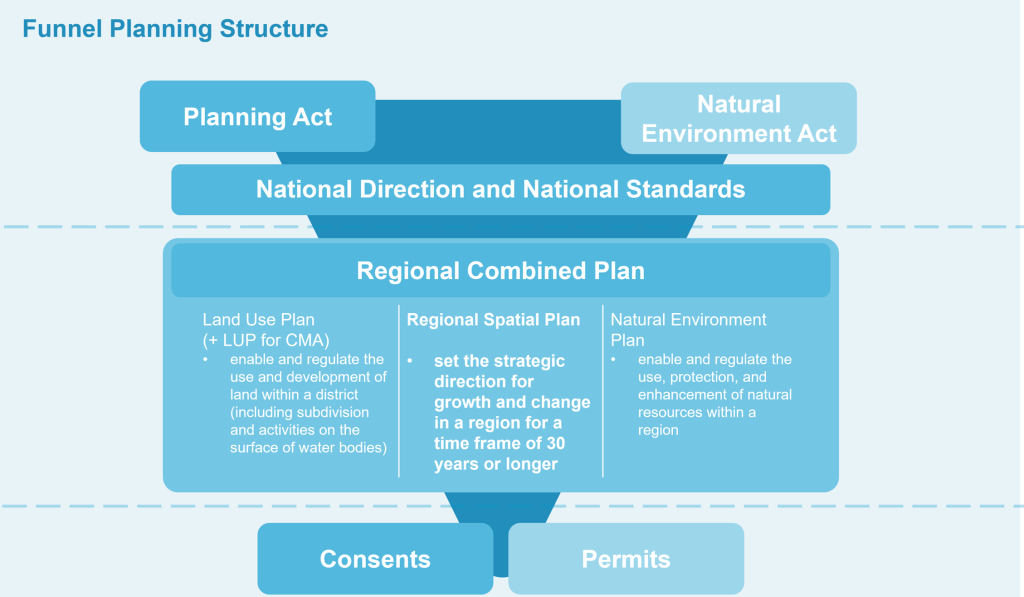
The new planning system is intended to be more directive and to prioritise the enjoyment of private property rights. At the top of the ‘funnel’, the Acts set the system’s overall goals and architecture. We have included a diagram of the ‘funnel’ structure at the end of this article.
National direction will give effect to those goals and processes, while also aiming to reconcile any conflicts between them. National standards and regulations will then translate that direction into processes, rules, methods and plan content.
Involvement in the national standard process is another way to influence the development of the new planning system, particularly if there is a good argument that activities and their associated effects could be regulated nationally, or within or across districts, regions, or any specified area (i.e., zone). The national standards may include objectives, policies, rules, methods or requirements and can direct that specific provisions be included in land use plans or RSPs. This means that a standardised approach can be determined at the national level and subsequently identified in RSPs which would mean that activities can be afforded more protection while the lower order planning documents are prepared.
RSPs will translate national standards into the long-term regional strategic direction by becoming part of a combined plan for each region. This combined plan will also contain each region’s land use and natural environment plans, which have the purposes of enabling and regulating development and enabling and regulating the use, protection, and enhancement of natural resources. System users sit below these lower order plans and apply for land use consents and natural environment permits.
Process agreements: Prepare now
Before draft RSPs are prepared and notified, authorities in each region must work together to prepare a ‘process agreement’. This agreement must explain how local authorities and the spatial plan committee will work together, divide responsibilities, make decisions, and meet obligations under any iwi participation legislation and joint management agreements.
Importantly, it must also set out how consultation will occur by identifying who local authorities consider to be relevant infrastructure providers, representatives of the development sector, representatives of other sector groups, and representatives of the wider community.
Process agreements shape pre-notification consultation on draft RSPs. A spatial plan committee must consult with the parties identified in the process agreement before publicly notifying a draft RSP. This means that these parties have the potential to have their priorities carried over into the RSPs.
Although spatial committees can consult ‘anyone else’ before notifying a draft RSP, key stakeholders should raise their planning priorities with local authorities early, before process agreements are settled if they want to be involved from the outset.
Want to know more?
If you have any questions about RSPs or how to get involved, please contact our specialist Environment and Planning team.
For more information contact: